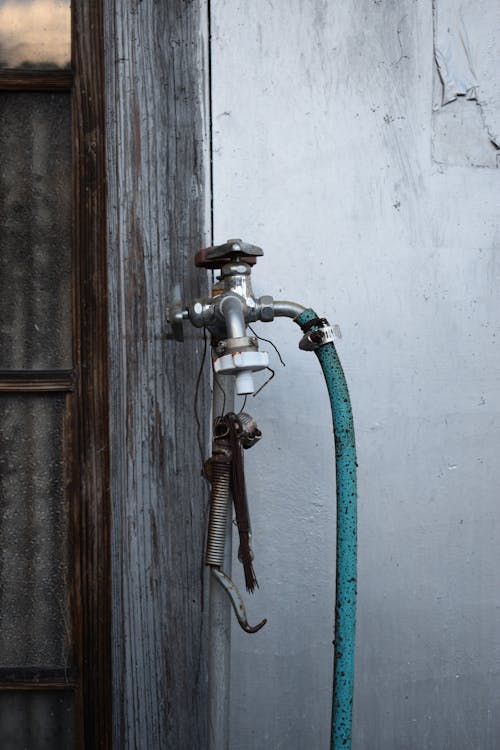
Spring arrives. The snow finally melts. You walk outside, grab the garden hose, turn the tap on for the first time since October — and nothing comes out. Or worse, water comes out somewhere it should not. Inside the wall. Under the floor. Somewhere you cannot see and did not plan for.
This happens across British Columbia every single spring. It is one of the most common causes of water damage we respond to in April and May, and it is almost entirely preventable. The problem is that the damage happens in winter, silently, behind the wall — and you do not find out until the first warm day when you reach for that hose.
Here is exactly what happens, why interior BC makes it worse, and what you can do about it.
What happens when a hose stays connected through winter
A garden hose connected to an outdoor tap traps water in the hose bib — the short section of pipe between the exterior wall and the shutoff valve inside. Normally, when you disconnect the hose in fall, any residual water in that section drains out by gravity. The pipe stays empty through winter and nothing freezes.
Leave the hose connected and that water has nowhere to go. It sits in the pipe. When temperatures drop below freezing — and in the Okanagan and interior BC, that can happen as early as October and as late as April — the water freezes. Ice expands. The pipe cracks.
Here is the critical detail: the crack is not on the outside of the house where you would notice it. It is inside the wall cavity, on the section of pipe between the exterior and the interior shutoff. You cannot see it. You cannot hear it. The pipe sits there cracked all winter, frozen solid, waiting for spring.
The silent damage pattern
Spring comes. You turn the tap on. Water flows through the supply line, hits the cracked section inside the wall, and starts leaking. Not a dramatic burst — usually a steady stream or a slow weep that runs down the inside of the wall framing.
If you are standing outside watching the hose and the flow seems weak, you might think the tap just needs to warm up. You leave it on. You go back inside. The water is now running inside your wall cavity, pooling on the bottom plate, soaking into the drywall from behind, and wicking into the subfloor below.
Some people do not notice for hours. Some do not notice for days or weeks — especially if the hose bib is on a side of the house they rarely check, or if the leak is slow enough that it does not produce visible staining on the interior wall right away. By the time you see a water stain on the baseboard or feel a soft spot in the floor, the damage has been spreading behind the scenes for a long time.
Why interior BC is especially bad for this
Coastal BC gets cold, but it rarely sees the sustained hard freezes that the interior does. In the Okanagan, Kamloops corridor, and Kootenays, winter temperatures routinely drop to minus 15 or colder for extended stretches. That is more than enough to freeze a hose bib solid.
But the real problem is the freeze-thaw cycling. Interior BC does not stay frozen all winter the way northern communities do. You get a week at minus 20, then a chinook pushes it to plus 5, then it drops again. Each cycle stresses the pipe further. A hairline crack from the first freeze becomes a proper split after three or four cycles.
North-facing walls are the worst. They get the least sun exposure and stay frozen the longest. Houses with crawlspaces — common in older Okanagan neighbourhoods — are particularly vulnerable because the pipes under the house have less thermal protection than those running through a heated basement. If your hose bib is on the north side of a house with a crawlspace, it is essentially the highest-risk scenario for this exact type of failure.
What to check before you turn that tap on
Before you use any exterior hose bib for the first time this spring, take five minutes and do this:
- Disconnect any hose that is still attached. If you left it connected all winter, remove it now before turning on the water.
- Visually inspect the hose bib. Look for cracks, splits, or any deformation in the brass or copper fitting. Check if the handle turns freely or feels seized.
- Turn the water on slowly. Open the tap just a quarter turn. Do not blast it on full. Give the system a chance to pressurize gradually.
- Go inside and check the wall. While the water is running outside, go to the interior wall where that hose bib pipe enters the house. Put your hand on the wall. Listen. Feel for moisture or vibration. Check the floor and baseboard below for any sign of water.
- Check crawlspace access if you have one. If you can get under the house, look at the pipe run from below. A cracked pipe under pressure will drip or spray visibly.
If everything looks dry after ten minutes with the water running, you are probably fine. If you see any moisture at all — on the wall, the floor, or under the house — shut the water off immediately and do not turn it back on until the pipe is repaired.
Prevention: what to do every fall
This is a completely preventable problem. Every fall, before the first hard freeze:
- Disconnect all garden hoses from every exterior tap. Drain the hoses and store them.
- Shut off the interior valve that feeds each hose bib, if your house has one. Then open the exterior tap to let any remaining water drain out.
- Consider frost-free hose bibs. These are designed with a long stem that places the shutoff valve well inside the heated envelope of the house, so the water never sits in the cold zone. If you are replacing a hose bib or building new, this is the standard in interior BC for good reason.
If you do one thing before October every year, make it this. Five minutes disconnecting hoses in the fall prevents thousands of dollars of hidden water damage in the spring.
What to do if you find damage
If you turned on the hose and found water where it should not be, do not wait. Do not assume it will dry on its own. Water inside a wall cavity does not dry — it spreads. Within 24 to 48 hours, you are looking at conditions that support mould growth. Within a week, you can have structural damage to framing and subfloor.
Shut the water off at the interior valve immediately. If you cannot find the valve for that specific line, shut off the main. A house without water for a day is inconvenient. A house with water running inside the walls is an emergency.
Do not ignore wet or discoloured drywall, soft spots in flooring, or a musty smell near an exterior wall. These are all signs that water has been present long enough to cause real damage. The 24-hour rule applies here: the faster you respond, the less damage there is to repair and the more likely your insurance will cover the restoration.
Spring revealed water damage you didn't expect?
If a frozen hose bib or burst pipe left you with water damage behind a wall, under a floor, or in a crawlspace, we can help. We will assess the full extent of the damage, explain exactly what needs to happen, and give you honest options. No pressure, no upselling. Free assessment.